Artificial Intelligence (AI) is evolving rapidly, and one of the most fascinating areas of development is AI memory systems. Just like humans rely on memory to learn, adapt, and make decisions, AI systems are also being designed to store, recall, and use information more intelligently.
But the big question is:
Can AI really remember everything like humans? Or even better?
In this article, we’ll explore how AI memory works, how it compares to human memory, its advantages, limitations, and what the future holds.
What Are AI Memory Systems?
AI memory systems are mechanisms that allow artificial intelligence to store and retrieve information over time. This memory helps AI systems improve performance, learn from past interactions, and make better decisions.
Unlike traditional software, which only follows fixed instructions, AI systems can:
- Learn from previous data
- Adapt based on user behavior
- Improve responses over time
For example, tools like ChatGPT can remember context within a conversation and provide more relevant answers.
Types of AI Memory
AI memory is not exactly the same as human memory. It is divided into different types based on how information is stored and used.
1. Short-Term Memory (Working Memory)
This type of memory is used to store temporary information.
Example:
- Remembering the current conversation
- Processing immediate inputs
Just like humans remember a phone number for a few seconds, AI systems use short-term memory for active tasks.
2. Long-Term Memory
Long-term memory allows AI to store information for extended periods.
Examples include:
- User preferences
- Historical data
- Learned patterns
This type of memory helps AI systems become more personalized over time.
3. Episodic Memory (Event-Based)
Episodic memory refers to remembering specific events or experiences.
In AI, this could mean:
- Remembering past interactions
- Tracking user actions
This helps AI understand context better.
4. Semantic Memory (Knowledge-Based)
This type of memory stores general knowledge.
For example:
- Facts
- Rules
- Language understanding
AI models trained on large datasets rely heavily on semantic memory.
How AI Memory Works
AI memory systems use technologies like:
1. Machine Learning
AI learns from data patterns and stores useful information for future use.
2. Neural Networks
Neural networks mimic the human brain’s structure. They process and store information through layers of interconnected nodes.
3. Databases and Storage Systems
AI uses databases to store large amounts of information and retrieve it when needed.
Companies like Google and Microsoft use advanced data storage systems to support AI memory.
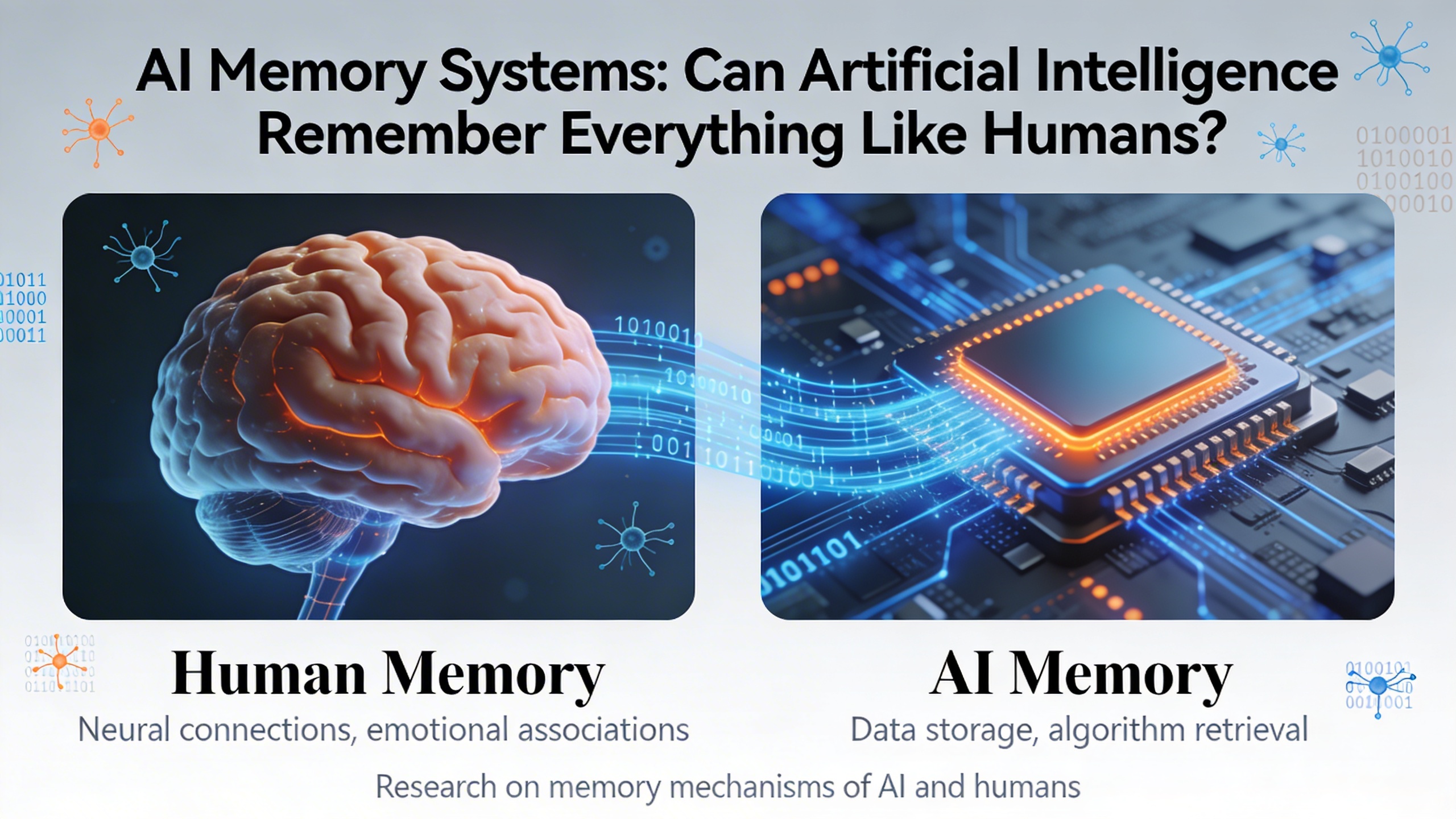
Human Memory vs AI Memory
Understanding the difference between human and AI memory is important.
Human Memory:
- Emotional and experience-based
- Can forget or distort information
- Limited storage capacity
- Creative and flexible
AI Memory:
- Data-driven and precise
- Can store vast amounts of information
- Does not forget unless programmed
- Fast and consistent
While humans rely on emotions and experiences, AI relies on data and algorithms.
Can AI Remember Everything?
Technically, AI has the potential to store massive amounts of data, much more than a human brain. However, remembering everything is not always practical or useful.
Why AI Cannot Remember Everything Perfectly:
- Data Overload: Too much data can slow down systems
- Relevance Issues: Not all information is important
- Storage Costs: Storing large data requires resources
- Privacy Concerns: Storing personal data raises ethical issues
So instead of remembering everything, AI focuses on remembering what matters most.
Benefits of AI Memory Systems
✔ Personalization
AI can remember user preferences and provide customized experiences.
✔ Improved Decision-Making
By using past data, AI can make smarter and faster decisions.
✔ Automation
AI can handle repetitive tasks based on learned behavior.
✔ Better User Experience
Memory helps AI provide more accurate and relevant responses.
Challenges of AI Memory
🔒 Privacy and Security
Storing user data creates risks if not handled properly.
⚠️ Bias in Data
AI memory depends on data. If the data is biased, the results will also be biased.
💻 High Resource Requirements
Advanced memory systems require powerful hardware and storage.
Real-World Applications
AI memory systems are already being used in many areas:
1. Virtual Assistants
Assistants like Google Assistant remember user preferences to provide better suggestions.
2. Recommendation Systems
Platforms suggest content based on past behavior.
3. Healthcare
AI tracks patient history and helps in diagnosis.
4. Business Analytics
Companies use AI memory to analyze customer behavior and improve services.
The Future of AI Memory Systems
The future of AI memory is extremely exciting. Researchers are working on systems that can:
- Understand context deeply
- Learn continuously
- Adapt like humans
- Combine memory with reasoning
Companies like OpenAI, Meta, and IBM are investing in advanced AI memory technologies.
In the future, AI may not only remember information but also understand experiences and context more like humans.
Conclusion
AI memory systems are a crucial part of modern artificial intelligence. They allow machines to learn, adapt, and improve over time.
While AI can store far more data than humans, it does not “remember” in the same way. Human memory is emotional and flexible, while AI memory is structured and data-driven.
So, can AI remember everything like humans?
Not exactly — but it can remember more, faster, and more accurately in many cases.
As technology continues to evolve, AI memory systems will become more advanced, bringing us closer to truly intelligent machines.
FAQ (Frequently Asked Questions)
1. What are AI memory systems?
AI memory systems allow artificial intelligence to store, recall, and use information over time.
2. Can AI remember everything?
AI can store large amounts of data, but it focuses on relevant information rather than everything.
3. How is AI memory different from human memory?
AI memory is data-driven and precise, while human memory is emotional and experience-based.
4. Where are AI memory systems used?
They are used in virtual assistants, recommendation systems, healthcare, and business analytics.
5. What is the future of AI memory?
Future AI systems will have more advanced memory, better context understanding, and improved learning capabilities.