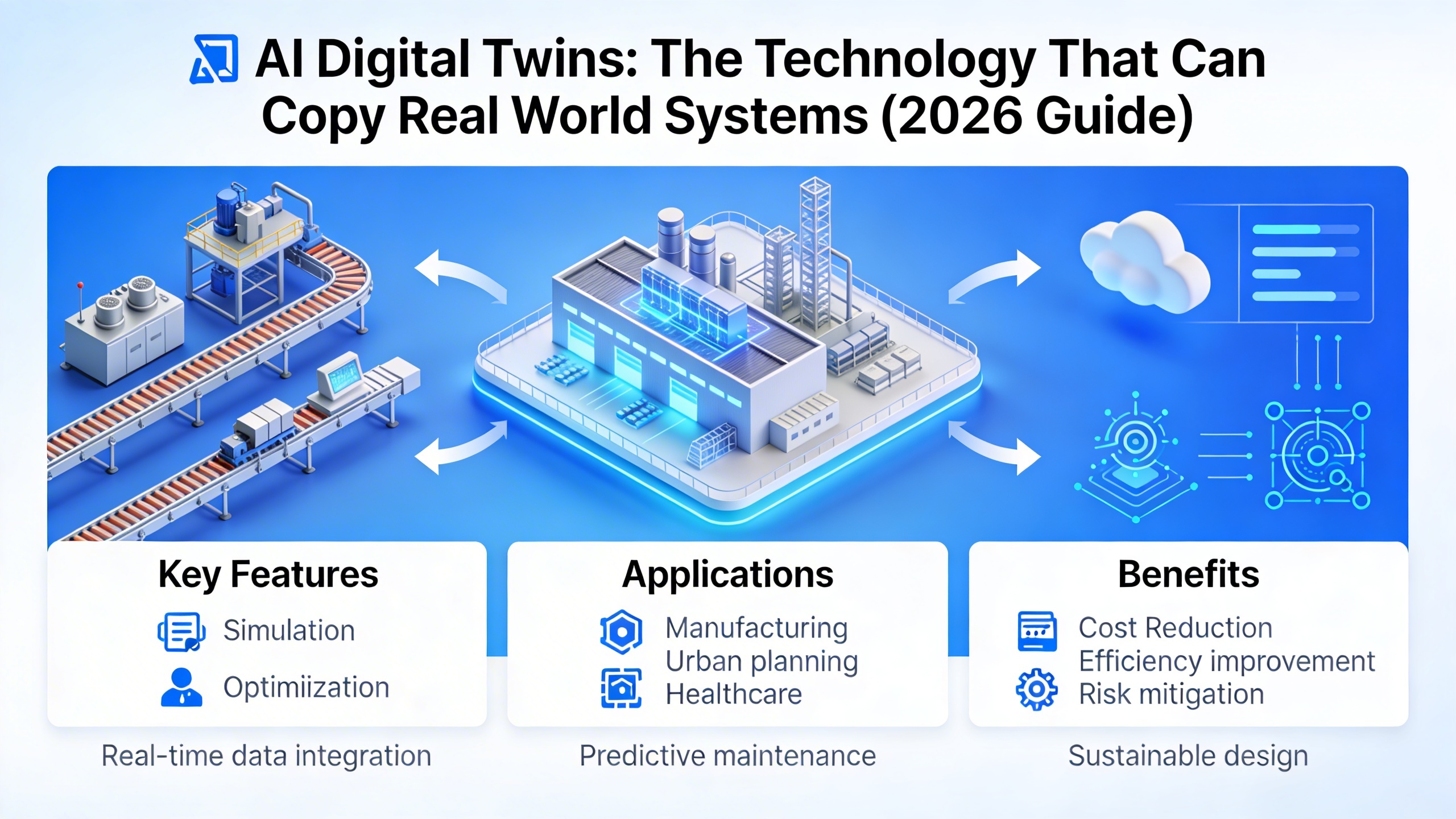
🚀 Introduction
What if you could create an exact digital copy of a real-world system—and test everything before it happens in reality?
That’s exactly what AI Digital Twins are doing in 2026.
From smart cities to healthcare and manufacturing, digital twin technology is helping businesses simulate, predict, and optimize real-world operations without risk.
👉 Imagine:
- Testing a factory without stopping production 🏭
- Predicting health issues before they happen ❤️
- Managing entire cities digitally 🌆
Welcome to the future of AI-powered simulation.
🤖 What Is a Digital Twin?
A Digital Twin is a virtual replica of a real-world object, system, or process.
It uses:
- Real-time data 📊
- Sensors 📡
- Artificial Intelligence 🧠
👉 This digital version behaves exactly like the real system.
⚙️ How AI Digital Twins Work
Digital twins combine multiple technologies:
🔄 Step-by-Step Process:
- Data Collection
Sensors collect real-time data from physical systems. - Digital Modeling
A virtual model is created. - AI Analysis
AI analyzes behavior and patterns. - Simulation & Prediction
The system predicts outcomes and suggests improvements.
👉 Result: Better decisions without real-world risk.
🧩 Key Components of Digital Twin Technology
📡 1. Sensors & IoT Devices
Collect real-time data from physical systems.
👉 Learn more:
🔗 https://en.wikipedia.org/wiki/Internet_of_things
🧠 2. Artificial Intelligence
AI processes data and predicts outcomes.
💻 3. Data Processing Systems
Handle large amounts of data quickly.
🌐 4. Cloud Computing
Stores and manages digital twin data.
🌟 Real-World Applications of AI Digital Twins
🏭 1. Manufacturing
Factories use digital twins to:
- Monitor machines ⚙️
- Predict failures 🔧
- Improve efficiency 📈
👉 Companies like Siemens use this technology.
🌆 2. Smart Cities
Cities create digital twins to:
- Manage traffic 🚦
- Reduce pollution 🌿
- Plan infrastructure 🏗️
❤️ 3. Healthcare
Digital twins can simulate human organs.
👉 Benefits:
- Predict diseases
- Test treatments
- Personalized healthcare
🚗 4. Automotive Industry
Car companies use digital twins to:
- Test vehicles virtually
- Improve safety
- Reduce development costs
✈️ 5. Aerospace
Used to:
- Monitor aircraft performance
- Predict maintenance needs
🌟 Benefits of AI Digital Twins
✅ Risk-Free Testing
Test scenarios without real-world damage.
✅ Better Decision Making
AI provides data-driven insights.
✅ Cost Reduction
Avoid expensive mistakes 💰
✅ Increased Efficiency
Optimize systems automatically ⚙️
✅ Predictive Maintenance
Fix problems before they happen 🔧
⚠️ Challenges of Digital Twin Technology
❌ High Setup Cost
Initial investment is expensive 💸
❌ Data Security Risks
Sensitive data must be protected 🔐
❌ Complex Implementation
Requires technical expertise 📘
❌ Data Accuracy Dependence
Incorrect data = wrong predictions
🔮 Future of AI Digital Twins
🚀 Full System Simulation
Entire industries will run digitally.
🌐 Integration with AI & IoT
More accurate and powerful systems.
🧠 Human Digital Twins
Virtual copies of humans for healthcare.
🤖 Autonomous Decision Systems
Systems will make decisions on their own.
📊 Why Digital Twins Are Important
Digital twins are becoming essential because they:
- Improve efficiency 📈
- Reduce risks ⚠️
- Enable innovation 🚀
👉 Businesses that adopt this technology early will have a huge advantage.
🏁 Conclusion
AI Digital Twins are transforming how we understand and manage the real world.
By creating virtual replicas of physical systems, businesses can:
- Test ideas
- Predict outcomes
- Optimize performance
👉 This technology is not just the future—it’s already here.
💬 Final Thoughts
If you want to stay ahead in 2026:
👉 Learn about AI and simulation technologies
👉 Explore digital twin applications
👉 Stay updated with tech trends
Because the future is not just digital—it’s a mirror of reality.
🔍 SEO Meta (AdSense Ready)
Meta Title:
AI Digital Twins Explained: Future of Simulation Technology (2026)
Meta Description:
Learn how AI digital twins work and how they replicate real-world systems. Discover benefits, uses, and future trends in 2026.
Keywords:
AI digital twins, digital twin technology, AI simulation, future tech 2026, IoT digital twin