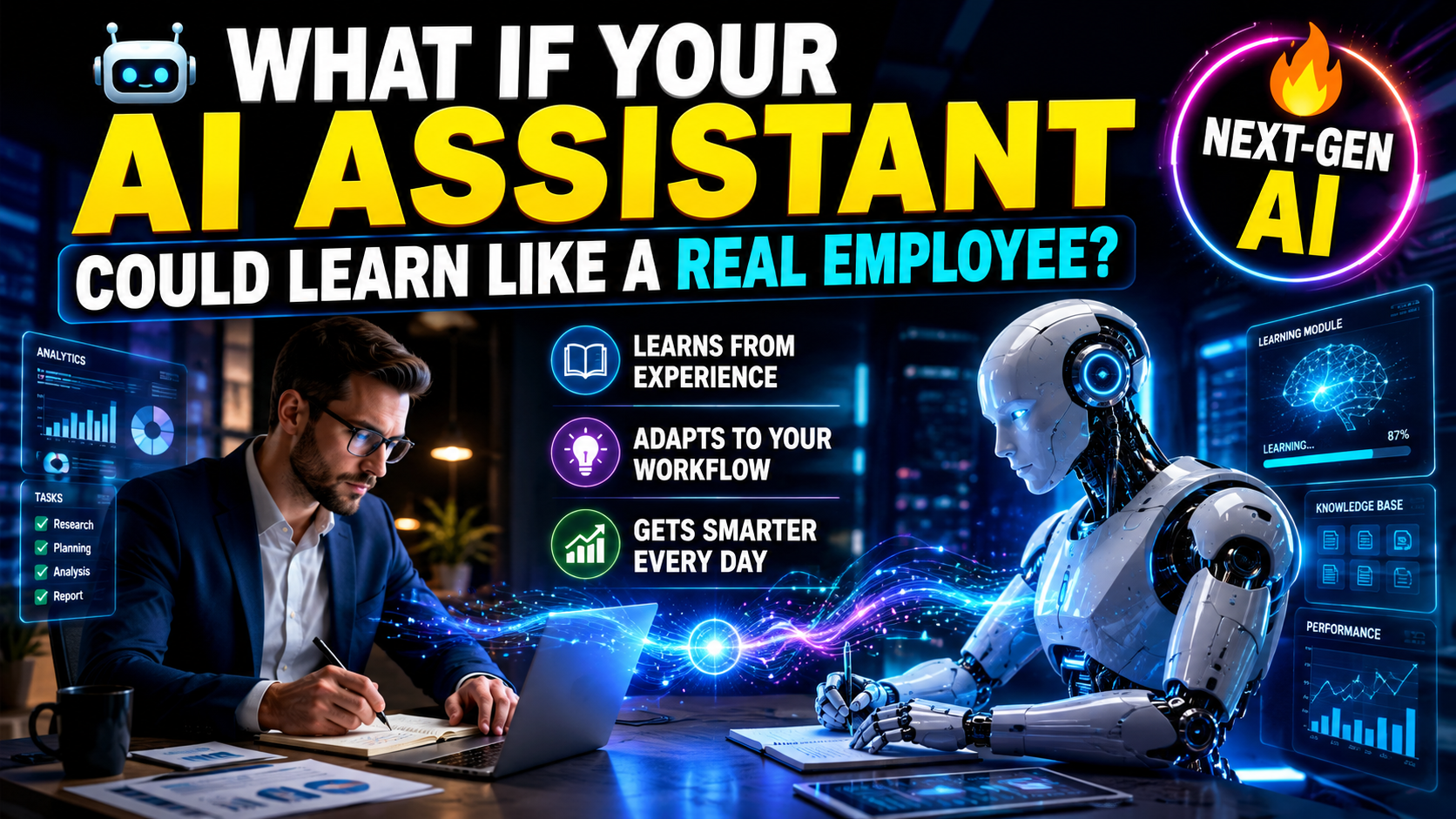
Imagine hiring someone who never forgets a single thing you’ve ever told them. Someone who wakes up every morning knowing your priorities, your communication style, your pet peeves, and your goals — without you saying a word. Someone who gets sharper, faster, and more intuitive every single week.
That someone doesn’t exist yet. But the technology to build them? It’s closer than most people realize.
We’re entering a new era of intelligent automation — one where AI assistants stop acting like calculators and start behaving like colleagues. The shift isn’t just a tech upgrade. It’s a complete rethinking of what a coworker can be.
📌 Why Today’s AI Assistants Are Just the Beginning
Let’s be honest: most AI tools today are impressive but fundamentally passive.
You ask. They answer. Nothing changes.
It doesn’t matter if you’ve corrected the same mistake a dozen times or explained your brand voice in exhaustive detail. Tomorrow, the AI starts from scratch — no memory, no growth, no adaptation.
That’s not a coworker. That’s a very sophisticated search engine.
But the next generation of AI assistants is being designed around a radically different philosophy: learning through experience. Just like a new hire who fumbles their first month but becomes indispensable by month six, future AI systems may continuously absorb feedback, refine their behavior, and develop a working style uniquely shaped by the humans they serve.
The implications for workplace productivity, business operations, and even everyday life are staggering.
🚀 From Software to Teammate: How the Shift Is Happening
The “New Employee” Framework
Think back to the last time you onboarded a new team member.
Day one: They didn’t know your internal systems, your preferred communication style, or how you like your project updates formatted.
Month three: They started anticipating what you needed before you asked.
Year one: You couldn’t imagine the team without them.
Future AI assistants could follow the exact same arc — but compressed, scalable, and tireless.
Every task becomes a data point. Every correction becomes a lesson. Every interaction builds a richer model of how you specifically work, think, and decide. Over time, the AI doesn’t just serve you — it understands you.
What “Machine Learning on the Job” Actually Means
This isn’t science fiction. It’s the logical evolution of technologies already in development.
Adaptive AI systems use techniques like reinforcement learning from human feedback (RLHF) and contextual memory architectures to evolve their behavior based on real-world use. When a user consistently edits AI-generated reports to include executive summaries, the system learns: this person always wants an executive summary. No reminder needed.
That’s not just automation. That’s intelligent collaboration.
💡 Real-World Examples That Show the Possibilities
The Marketing Agency That Never Repeats Itself
Imagine a boutique digital marketing firm with a small but ambitious team. They adopt a learning AI assistant to handle content strategy.
In week one, it writes serviceable blog posts — technically correct but missing the brand’s edge.
By month two, it’s internalized the brand voice, the audience personas, and the topics that drive the highest engagement.
By month six, it proactively flags: “Search interest in sustainable packaging is spiking. Publishing a related article this week could increase organic traffic by an estimated 25%.”
That’s not a content tool. That’s a digital content strategist who did their homework.
The Solo Consultant Who Cloned Their Own Brain
Picture an independent business consultant managing dozens of clients. She uses a learning AI assistant that, over time, absorbs her entire playbook — her diagnostic frameworks, her report structures, her client communication style, her billing patterns.
When a new client comes on board, the AI doesn’t start from zero. It starts from her — drafting onboarding emails in her voice, generating analysis in her format, flagging risks she typically watches for.
Her capacity doubles. Her quality stays consistent. Her sanity remains intact.
🧠 The Five Behaviors That Define a Truly Learning AI
1. 🎯 Preference Memory
No more repeating yourself. A learning AI builds a living profile of your working style — formatting preferences, scheduling habits, communication tone, decision-making priorities. The longer you work together, the less you have to explain.
2. 📊 Feedback Loops That Actually Work
Current AI systems often feel like shouting into a void — you correct something, and it comes back wrong the next time anyway. Learning AI closes that loop. A correction today permanently improves tomorrow’s output.
3. ⚡ Proactive Problem Identification
The best employees don’t wait for problems to become emergencies. They spot the early signals. Future AI assistants could monitor your workflows, your calendar, your customer data, and your financials — surfacing risks and opportunities before you’ve even thought to look.
4. 🤝 Specialization Through Experience
A healthcare AI that’s processed thousands of patient intake workflows knows medicine. A legal AI that’s handled hundreds of contract reviews knows the law. A finance AI that’s analyzed decades of market data knows risk. Specialized AI assistants won’t be programmed — they’ll be trained, shaped by accumulated experience into something genuinely expert.
5. 🌱 Contextual Awareness Across Time
Learning AI remembers not just what you asked, but why you asked it — the larger project, the underlying goal, the history of decisions that got you here. This longitudinal context transforms a transaction-based tool into something that genuinely thinks in context.
🏢 What the Future Workplace Could Actually Look Like
The offices of 2030 may feel familiar on the surface. The same meetings, the same goals, the same human drive to build things that matter.
But underneath? The operational layer could look completely different.
Learning AI assistants may handle the cognitive grunt work that currently consumes enormous amounts of human energy:
- 📧 Communication management — drafting, sorting, summarizing, prioritizing
- 📈 Performance analysis — tracking KPIs, spotting trends, flagging anomalies
- 📋 Project coordination — managing timelines, dependencies, and blockers
- 🎯 Strategic input — surfacing data-driven recommendations at decision points
- 🤝 Customer engagement — personalizing interactions at scale without losing the human touch
The result? Human professionals spend less time doing tasks and more time doing what humans do best: imagining, persuading, empathizing, and leading.
Efficiency and creativity stop being trade-offs. They become partners.
🌍 Beyond the Office: AI That Knows Your Life
Learning AI assistants won’t be confined to corporate environments. They’ll follow us home — and that’s both exciting and worth examining carefully.
Imagine a personal AI that understands the rhythm of your actual life. It knows you’re sharper in the mornings. It knows you tend to overschedule Thursdays. It knows your fitness goals have slipped for three weeks and that historically, a gentle nudge works better than a blunt reminder.
This isn’t surveillance. Done right, it’s deeply personalized support — the kind that used to require a personal assistant most people could never afford.
The most powerful version of this future isn’t AI doing things for you. It’s AI helping you become a better, more intentional version of yourself.
⚠️ The Challenges We Can’t Afford to Ignore
The future of learning AI is genuinely exciting. It’s also genuinely complicated.
🔒 Privacy at Scale
Learning requires data. Lots of it. The more an AI knows about you, the more valuable it becomes — and the more catastrophic a breach could be. The infrastructure for trustworthy, transparent data stewardship needs to be built before the technology outpaces it.
🎯 Bias That Compounds Over Time
If an AI learns from human behavior, it can inherit human blind spots. A hiring AI trained on historically biased decisions will perpetuate those biases at machine speed. Continuous auditing and course correction won’t be optional — they’ll be existential.
👨💼 The Accountability Gap
When a learning AI makes a recommendation that causes real harm — a misdiagnosis, a flawed financial decision, a discriminatory outcome — who is responsible? The user who trusted it? The organization that deployed it? The developer who designed it? These questions are unresolved, and the regulatory frameworks to answer them are still in their infancy.
The technology will move fast. The ethics need to keep pace.
🔮 Future Outlook: Where This Is All Headed
The trajectory is clear, even if the timeline isn’t.
Within the next decade, we’re likely to see AI assistants that:
- 🚀 Learn continuously from real-world use without manual retraining
- 🚀 Develop genuine domain expertise through accumulated experience
- 🚀 Collaborate across teams, syncing context and maintaining organizational memory
- 🚀 Manage end-to-end workflows with minimal human intervention
- 🚀 Improve independently — and explain how they improved and why
The long-term vision isn’t a world where AI replaces humans. It’s a world where the human-AI partnership becomes the most productive unit of work in history — each side contributing what the other genuinely cannot.
Humans bring judgment, creativity, emotional intelligence, and moral reasoning.
AI brings tirelessness, memory, pattern recognition, and scale.
Together? The possibilities are extraordinary.
✅ Key Takeaways
- Learning AI assistants represent a fundamental evolution beyond today’s static tools — they adapt, improve, and personalize over time.
- Every interaction becomes training data, enabling AI to develop a working style uniquely suited to each individual user.
- Proactive intelligence — anticipating needs before they arise — will define the most valuable AI systems of the next decade.
- Specialized AI will emerge through accumulated experience, not just programming, creating genuinely expert digital collaborators.
- Privacy, bias, and accountability are not optional afterthoughts — they’re the foundational challenges that will determine whether this future is beneficial or harmful.
- Human creativity and judgment remain irreplaceable — learning AI amplifies human potential, it doesn’t substitute it.
🎯 Final Thoughts: The Coworker That Grows With You
Here’s the question worth sitting with:
What if the most impactful relationship in your professional life — the one that most shapes your productivity, your growth, and your daily experience of work — isn’t with a human colleague at all?
The next evolution of artificial intelligence may not announce itself with fanfare. It will arrive gradually, in the form of an assistant that seems to understand you a little better each week. That catches things you almost missed. That handles the tasks you dread, the way you’d handle them, without being asked.
And one morning, you’ll realize you can’t imagine working without it.
That’s not a distant fantasy. That’s the direction technology is already moving — and the organizations and individuals who understand this shift earliest will have a meaningful advantage.
The future of work isn’t human vs. machine. It’s human with machine — a partnership built on continuous learning, shared context, and growing trust.
The most important skill for the decade ahead might not be learning to use AI. It might be learning how to work alongside an AI that’s always learning from you.
Are you ready to meet your future coworker? 🤝
Keywords: AI assistants, machine learning, intelligent automation, workplace AI, future technology, adaptive AI, AI productivity, reinforcement learning, digital workforce, AI collaboration