The idea sounds powerful.
A machine analyzing millions of data points in seconds.
Detecting patterns humans can’t see.
Predicting stock movements before they happen.
But the real question is:
Can AI actually predict the stock market reliably?
Or is it just another overhyped technology?
Let’s break this down with logic, data thinking, and quality analysis — not emotional assumptions.
1️⃣ What Does “AI in Stock Market” Actually Mean?
When people say AI predicts the stock market, they usually mean:
- Machine learning models analyzing historical price data
- Algorithms studying volume, volatility, and trends
- Sentiment analysis from news and social media
- High-frequency trading systems
Major financial institutions use AI systems developed with technologies from companies like:
- IBM
- Microsoft
These systems process:
- Historical stock prices
- Economic indicators
- Interest rates
- Global news
- Corporate earnings reports
AI does not “guess.”
It finds statistical probabilities.
And that difference matters.
2️⃣ Where AI Actually Performs Well
AI is strong in three main areas:
📊 Pattern Recognition
Markets move in patterns — trends, cycles, momentum shifts.
AI models detect:
- Breakout patterns
- Support and resistance zones
- Abnormal trading activity
- Correlation between assets
Humans may miss micro-patterns.
AI doesn’t get tired.
⚡ Speed & High-Frequency Trading
Some hedge funds use algorithmic trading systems that execute trades in milliseconds.
Companies like Renaissance Technologies rely heavily on quantitative models.
In high-frequency environments, speed matters more than prediction.
AI excels here.
📰 Sentiment Analysis
AI scans:
- News headlines
- Financial reports
- Social media discussions
- CEO statements
It measures positive or negative sentiment instantly.
A human can read 10 articles.
AI can analyze 10,000 in seconds.
3️⃣ Where AI Struggles (The Reality)
Here’s the uncomfortable truth:
The stock market is not purely mathematical.
It’s psychological.
AI struggles with:
- Black swan events (unexpected crises)
- Political shocks
- War situations
- Sudden regulatory changes
- Emotional panic selling
For example:
During global crises like the 2008 financial crash or pandemic-level uncertainty, historical data becomes less reliable.
AI models trained on past data cannot perfectly predict unprecedented events.
Markets are influenced by fear, greed, and irrational behavior.
Humans are unpredictable.
4️⃣ Retail Investors vs Institutional AI
There’s a huge difference between:
- Institutional-grade AI systems
- Retail trading apps claiming “AI predictions”
Big institutions:
- Spend millions on research
- Use advanced data infrastructure
- Employ quantitative analysts
Retail apps often use simplified algorithms.
So when someone says, “AI predicted this stock,” ask:
Which AI?
What data?
What time frame?
What probability?
Reliability depends on system quality.
5️⃣ Is AI More Reliable Than Humans?
Short answer:
In data analysis → Yes.
In long-term certainty → No.
AI reduces:
- Emotional bias
- Overtrading
- Impulsive decisions
Humans often:
- Panic sell
- Chase hype
- Ignore risk management
AI sticks to rules.
But AI can also:
- Overfit historical data
- Fail during regime shifts
- Misinterpret rare events
Reliability in markets is never 100%.
It’s probability-based.
6️⃣ The Role of Machine Learning Models
Common AI techniques used in stock prediction include:
- Neural networks
- Reinforcement learning
- Time-series forecasting
- Natural language processing
These systems train on historical data to predict future movement probabilities.
But markets evolve.
What worked 5 years ago may not work today.
That’s why models need continuous retraining.
7️⃣ AI + Human Strategy = Better Results
The smartest approach is not:
“AI replaces traders.”
It is:
“AI assists decision-making.”
Professional traders often:
- Use AI for signal generation
- Combine it with fundamental analysis
- Add macroeconomic understanding
- Apply strict risk management
AI provides data-driven insight.
Humans provide contextual judgment.
Together, they reduce risk.
8️⃣ Long-Term Investing vs Short-Term Prediction
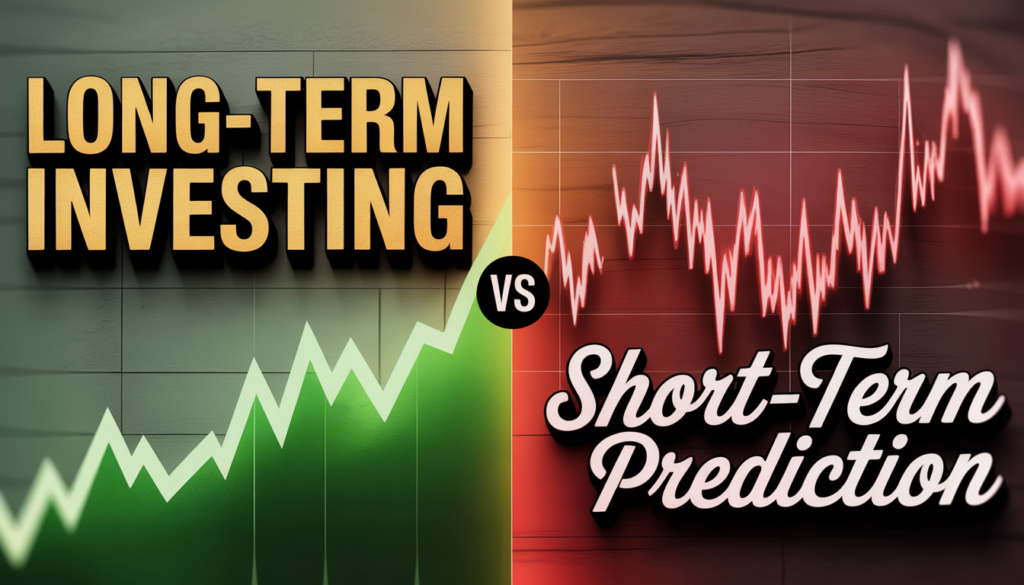
AI is generally more effective in:
- Short-term trading patterns
- Statistical arbitrage
- Automated execution
For long-term investing:
Fundamental factors matter:
- Company revenue growth
- Management quality
- Competitive advantage
- Industry trends
AI can help analyze these factors, but long-term investing requires business understanding.
9️⃣ Can AI Guarantee Profits?
No.
And any platform claiming guaranteed profits using AI should be treated cautiously.
Stock markets involve:
- Risk
- Volatility
- Uncertainty
AI increases analytical power.
It does not eliminate risk.
Even advanced quantitative funds experience losses.
🔟 So, Is AI Reliable?
The honest answer:
AI is reliable as a tool.
It is not reliable as a guarantee.
It improves:
- Speed
- Data processing
- Pattern detection
- Discipline
It cannot:
- Predict unpredictable global shocks
- Remove market uncertainty
- Guarantee profits
Reliability in markets is about probability management.
Not certainty.
📌 Final Verdict (Quality Perspective)
AI in stock market prediction is:
✔ Powerful
✔ Data-driven
✔ Useful for institutional trading
✔ Helpful for reducing emotional bias
But it is not:
✖ A magic formula
✖ 100% accurate
✖ Risk-free
The market remains dynamic and complex.
The best approach?
Use AI for analysis.
Use human judgment for strategy.
Use risk management for survival.