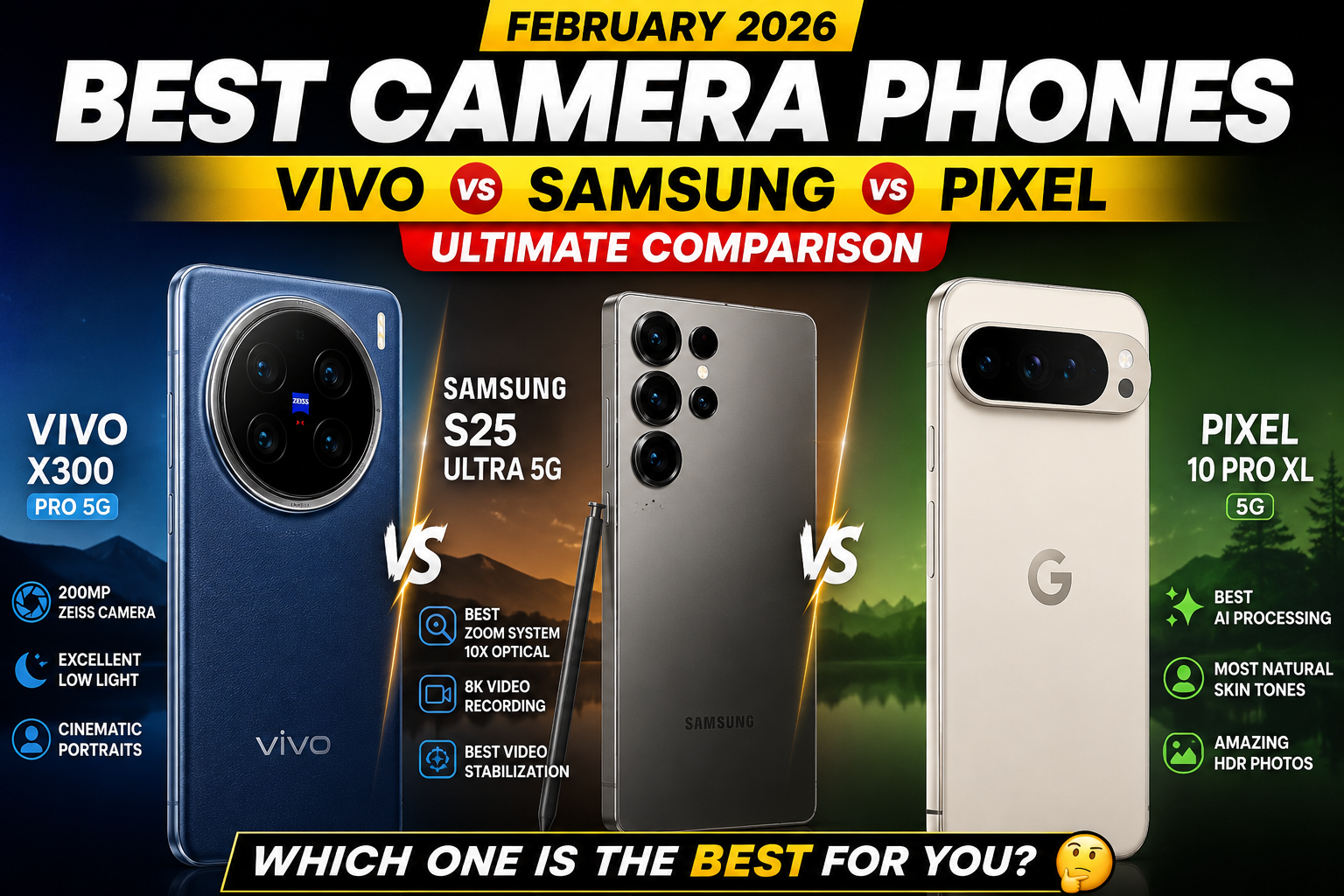
The smartphone camera war in 2026 is no longer about megapixels alone. Every major brand now uses artificial intelligence, computational photography, advanced sensors, and cinematic software processing to create photos that look almost professional directly from the phone.
But three brands are dominating the conversation right now:
- Vivo
- Samsung
Each company follows a completely different camera philosophy.
Samsung focuses on versatility and zoom power.
Google focuses on AI photography and realistic image processing.
Vivo focuses on cinematic portraits and professional-looking shots.
And honestly, the competition has become so intense that choosing the best camera phone in 2026 depends more on your photography style than pure hardware numbers.
Why Smartphone Cameras Feel So Different in 2026
Modern flagship smartphones now rely heavily on:
- AI image enhancement
- Computational photography
- Real-time HDR processing
- AI portrait engines
- Smart zoom optimization
- Cinematic video stabilization
- Night photography algorithms
That means camera quality is no longer decided only by sensors.
Software now controls:
- Skin tones
- Dynamic range
- Sharpness
- Color science
- Background blur
- Low-light detail
This is exactly why Vivo, Samsung, and Pixel phones produce completely different photo styles even when camera hardware looks similar.
Samsung Galaxy S26 Ultra – The Ultimate All-Rounder Camera Phone
Samsung continues dominating the flagship Android market with the Galaxy S26 Ultra, and camera performance remains one of its biggest strengths.
The phone reportedly includes:
- 200MP primary camera
- Dual telephoto zoom lenses
- 50MP ultrawide camera
- Advanced Galaxy AI photography
- 8K video recording
- AI zoom enhancement
Samsung’s biggest advantage is versatility.
The S26 Ultra performs strongly in:
- Long-range zoom photography
- Daylight photography
- Social-media-ready images
- Ultra-wide shots
- Video recording
- HDR performance
According to recent camera testing reports, the Galaxy S26 Ultra delivers excellent detail and consistent image quality across multiple lighting conditions.
Samsung’s AI camera system also improves:
- Subject tracking
- Scene recognition
- AI object cleanup
- Portrait lighting
- Motion correction
For users who want one phone that does everything well, Samsung remains one of the safest flagship camera choices in 2026.
Vivo X300 Pro and Vivo V70 – Portrait Photography Kings
Vivo is becoming increasingly dangerous in the camera smartphone market.
The company’s partnership with ZEISS is now producing some of the most cinematic smartphone photography available.
The Vivo X300 Pro and Vivo V70 Series focus heavily on:
- Portrait photography
- Natural skin tones
- Cinematic blur
- Low-light performance
- Professional color tuning
- AI beauty optimization
The Vivo V70 Series reportedly features:
- ZEISS-engineered 50MP camera setup
- Dedicated portrait lens
- AI portrait enhancement
- Smart facial optimization
- Advanced low-light portrait modes
Meanwhile, the Vivo X300 Pro pushes things even further with:
- Large camera sensors
- 200MP periscope zoom
- Dolby Vision HDR recording
- 4K cinematic video
- ZEISS T* coating
Notebookcheck rankings recently placed the Vivo X300 Pro among the highest-rated smartphone cameras tested in 2026.
What makes Vivo special is its portrait photography.
Human faces often look:
- More natural
- Better lit
- More cinematic
- Less artificially sharpened
Compared to many competitors.
That is why many content creators, influencers, and portrait photography lovers are increasingly choosing Vivo devices.
Google Pixel 10a and Pixel 10 Pro – AI Photography Masters
Google still dominates one critical category:
Computational photography.
Pixel phones often produce images that feel more realistic than heavily processed flagship competitors.
The Pixel 10 lineup reportedly focuses on:
- AI-enhanced photography
- Smart HDR balancing
- AI object removal
- Realistic skin tones
- Better low-light photography
- Intelligent portrait processing
Google’s Tensor chipset and Gemini AI integration allow the phone to process images differently compared to Samsung and Vivo.
Instead of creating highly saturated social-media-style images, Pixel phones usually aim for:
- Natural colors
- Accurate shadows
- Balanced highlights
- Real-world skin tones
Digital Camera World recently praised the Pixel 10 Pro series for exceptional still photography and AI-assisted zoom performance.
The Pixel 10a also remains one of the strongest affordable AI camera phones because of:
- Smart software optimization
- Reliable point-and-shoot photography
- Strong night photography
- Clean Android experience
Google’s biggest strength is simplicity.
Users can simply point the camera and capture excellent photos without manual adjustments.
Zoom Photography Comparison – Samsung Still Leads
When it comes to zoom photography, Samsung remains extremely strong.
The Galaxy S26 Ultra includes:
- Multiple telephoto systems
- AI zoom enhancement
- Advanced stabilization
- Long-distance image clarity
Recent comparisons show Samsung performing especially well in:
- 10x zoom photography
- Daylight detail capture
- Long-distance sharpness
Vivo’s zoom hardware is also becoming very powerful, especially with large periscope sensors.
But Samsung’s zoom consistency and software processing still give it a strong advantage overall.
Portrait Photography Comparison – Vivo Takes the Crown
This is where Vivo becomes extremely difficult to beat.
The combination of:
- ZEISS tuning
- AI facial processing
- Cinematic blur
- Better edge detection
- Natural skin tone rendering
Makes Vivo one of the best portrait smartphone brands in the world right now.
Community discussions and real-world reviews repeatedly praise Vivo’s portrait performance and video quality.
For:
- Instagram creators
- Fashion photography
- Selfies
- Cinematic portraits
- Social-media content
Vivo may currently hold the strongest advantage.
Low-Light Photography Battle
Low-light photography has improved massively across all flagship smartphones in 2026.
Here’s where each brand performs best:
Samsung
- Brighter night shots
- Strong AI sharpening
- Better stabilization
Vivo
- More cinematic night portraits
- Better natural lighting balance
- Cleaner skin textures
Pixel
- More realistic night processing
- Excellent shadow detail
- Balanced HDR
Tom’s Guide comparisons recently showed Vivo performing especially well in portrait and low-light photography against Samsung flagships.
Video Recording Comparison
For video creators, all three brands offer different strengths.
Samsung
Best for:
- Stabilization
- Zoom video
- Social-media-ready footage
- Versatility
Vivo
Best for:
- Cinematic portrait videos
- Color science
- Professional-style footage
Pixel
Best for:
- Natural tones
- AI stabilization
- Simplicity
Samsung still feels like the most balanced overall video package for most users.
But Vivo is becoming increasingly competitive in cinematic recording quality.
AI Camera Features Are Changing Everything
Artificial intelligence now controls almost every major camera function.
Modern AI camera systems can:
- Remove unwanted objects
- Improve portraits automatically
- Enhance low-light detail
- Adjust facial lighting
- Stabilize video intelligently
- Optimize HDR instantly
Samsung uses Galaxy AI.
Google uses Gemini AI and computational photography.
Vivo focuses heavily on AI portrait enhancement.
This AI race is becoming just as important as camera hardware itself.
Community Reactions in 2026
Online discussions reveal interesting trends.
Many users believe:
- Vivo currently produces the best portraits
- Samsung remains the safest all-round flagship
- Pixel offers the smartest AI photography
Some Reddit users even argue that differences between flagship smartphone cameras are becoming harder to notice unless users are highly experienced photographers.
And honestly, they are partly correct.
Modern flagship phones are now incredibly good overall.
Which Camera Phone Should You Choose?
Choose Samsung Galaxy S26 Ultra If You Want:
- Best zoom photography
- Balanced flagship performance
- Strong video recording
- Versatile camera system
- Premium all-round experience
Choose Vivo X300 Pro or Vivo V70 If You Want:
- Best portrait photography
- Cinematic selfies
- Social-media-ready photos
- Professional-looking skin tones
- Artistic photography style
Choose Google Pixel 10 Series If You Want:
- Natural-looking photos
- Smart AI camera tools
- Reliable point-and-shoot photography
- Clean Android experience
- Realistic image processing
Final Verdict – Who Wins the Camera Battle?
There is no single perfect winner anymore.
Samsung wins in versatility.
Vivo wins in portraits and cinematic style.
Pixel wins in AI photography and natural image processing.
And honestly, that is what makes the smartphone camera industry so exciting in 2026.
These phones are no longer just replacing cameras.
They are redefining how normal people create memories, videos, and content every single day.