The answer isn’t really about technology. It’s about human psychology — and a trillion-dollar business problem that a blinking text cursor was never going to solve.
The Chatbot Hit a Wall
Chatbots were remarkable when they arrived. Suddenly, a business could handle thousands of customer queries simultaneously, at any hour, at almost zero marginal cost. That was genuinely revolutionary.
But something quietly broke. People started hating them.
Not because they were slow or wrong — but because they felt cold. Transactional. Like filling out a form that talks back. Users learned to route around chatbots the way water routes around a rock, aggressively typing “speak to a human” within the first two messages.
The technology got smarter. The problem didn’t go away. Because the problem was never intelligence — it was presence.
What Digital Humans Actually Are
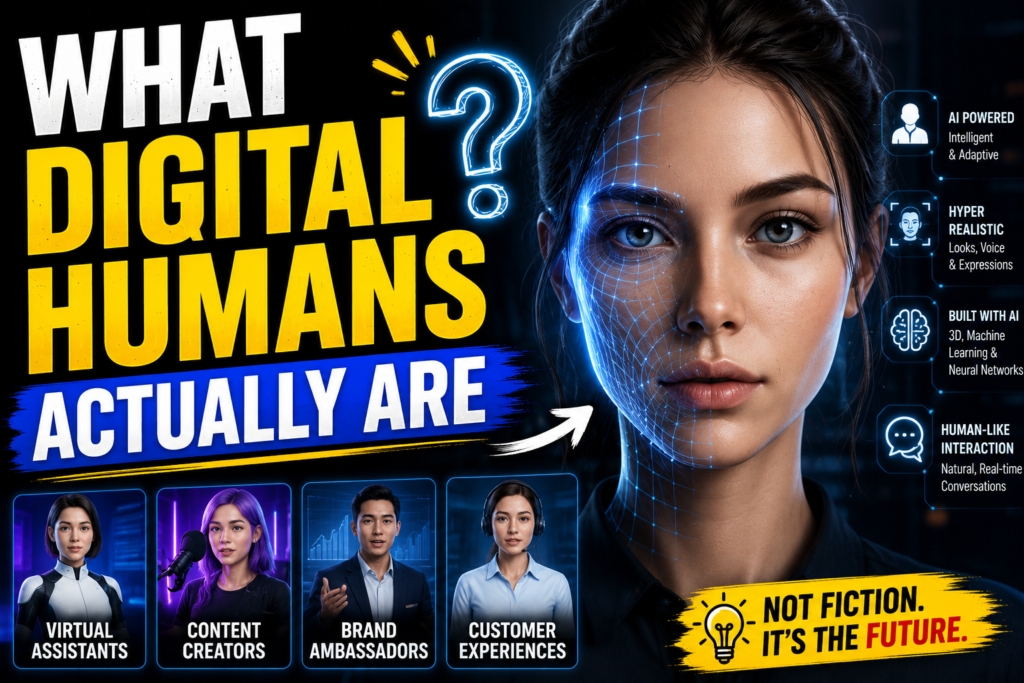
A digital human is not just a chatbot with a face glued on. That’s the misconception worth clearing up first.
Digital humans are designed to interpret verbal speech, facial expressions, gestures, sentiments, images, video, and audio. Critically, they can respond not just with words, but with their own speech, tone, and body language. Gartner
They are, in essence, a complete communication system — one that mirrors how humans actually talk to each other, not just how they type queries into a search box.
The Numbers Reveal a Conviction Bet
This isn’t a niche experiment. The money moving into this space signals serious industry conviction.
The digital human market is projected to grow from $6.28 billion in 2025 to more than $26 billion by 2031, a compound annual growth rate of nearly 27% — and that growth is being driven by enterprises, not consumers. TheStreet
Meanwhile, the global digital human market overall is expected to grow at a compound annual growth rate of 46.59%, according to Kings Research. Kingsresearch
When enterprise technology budgets shift this decisively, something fundamental is changing in how companies think about customer interaction.
The Real Reason: Human Psychology Doesn’t Read Text, It Reads Faces
Here’s what the research keeps finding, and what AI companies have clearly internalized:
More human-like agents enhance mind attribution, trust, and social presence — affecting whether they are seen as tools, companions, or social peers. Engagement is driven by social and emotional mechanisms, such as trust and expectation alignment, reinforcing AI as a social entity. Frontiers
In plain language: when something looks and sounds human, our brains treat it differently. We attribute intention to it. We extend it patience. We listen more carefully. We trust it more readily.
This is not a design preference — it is a cognitive reflex hundreds of thousands of years in the making. AI companies are building to that reflex, not against it.
The Engagement Gap Chatbots Could Never Close
Engagement isn’t just about getting the right answer. It’s about feeling understood in the process. Humans communicate through so much more than words — tone, pacing, facial expressions, body language — these all contribute to whether an interaction feels supportive or dismissive, helpful or frustrating. CodeBaby
A chatbot, no matter how sophisticated, can only operate in one channel: text. A digital human operates in all of them simultaneously. And the downstream effect on user experience is measurable.
Studies reveal that expressive virtual avatars improve both knowledge retention and emotional connection — making learning feel more human. D-ID
For industries like healthcare, education, and financial services — where the quality of the interaction is directly tied to the outcome — this difference isn’t cosmetic. It’s fundamental.
The Business Case: Scalable Presence
Beyond psychology, there’s a cold commercial logic driving this shift.
Companies are beginning to think about digital employees the way they think about software licenses — scalable assets that can be deployed, configured, and expanded as business needs change. Startup Pill
Think about what that means in practice. A luxury retail brand could deploy a digital human that embodies its brand voice perfectly, speaks 40 languages, never has an off day, and handles 100,000 simultaneous customer conversations — each one feeling personal and attentive.
That’s not a chatbot upgrade. That’s a fundamentally different business capability.
The Trust Problem — And How Companies Are Solving It
There’s a legitimate challenge here that serious players are honest about. User skepticism around AI avatars remains a genuine challenge, particularly when an interaction feels close to human but not quite right. This is the famous “uncanny valley” — the eerie discomfort triggered when something is almost human but not quite. TheStreet
Hyperrealistic avatars that are almost but not quite human can actually undermine trust rather than build it. There’s a sweet spot where digital humans are clearly artificial but still feel warm and communicative. CodeBaby
The solution the industry has converged on is transparency, not deception. Trust tends to come from consistency, transparency about what users are interacting with, and whether the system reliably delivers value. If a digital human helps someone get what they need quickly, the skepticism tends to fade. TheStreet
Where They’re Actually Being Deployed Right Now
The most interesting deployments aren’t in science fiction — they’re already running in industries you interact with every day:
Healthcare — Digital human intake coordinators that can read patient anxiety and adjust their pace and tone accordingly. A text form cannot do that.
Financial Services — AI advisors that walk clients through complex products in a conversational way, building comprehension rather than compliance.
Education — Teams can quickly create avatars that act as trainers or guides explaining complex topics step by step, making training accessible across global teams. D-ID
Corporate Training — Synthesia allows businesses to produce AI avatars for training, marketing, and corporate communications without live actors, saving significant time and money. Kingsresearch
The Bigger Picture: AI Is Becoming Infrastructure
IBM’s AI researchers predict we’ll soon start seeing multimodal digital workers that can autonomously complete different tasks — interpreting things, handling complex cases — while bridging language, vision, and action together. IBM
The shift from chatbots to digital humans is really a shift in philosophy. A chatbot is a tool you use. A digital human is an entity you interact with. That distinction changes everything — how users engage, how much they trust it, how long they stay, and how likely they are to come back.
As AI moves deeper into business operations, the demand for more natural interfaces is growing. The chatbot was always a bridge technology — impressive for its time, but fundamentally limited by the coldness of text. TheStreet
The Bottom Line
AI companies aren’t chasing digital humans because it’s a trend. They’re chasing them because the data is clear: humans respond better to faces than to text boxes, and they always have.
The companies that crack this — presence at scale, trust without deception, empathy without a human on the other end — won’t just be building better chatbots. They’ll be redefining what it means to show up in a digital world.
And in a world where attention is the scarcest resource, showing up as a face, a voice, and a presence rather than a blinking cursor? That’s not a small advantage. That’s the whole game.