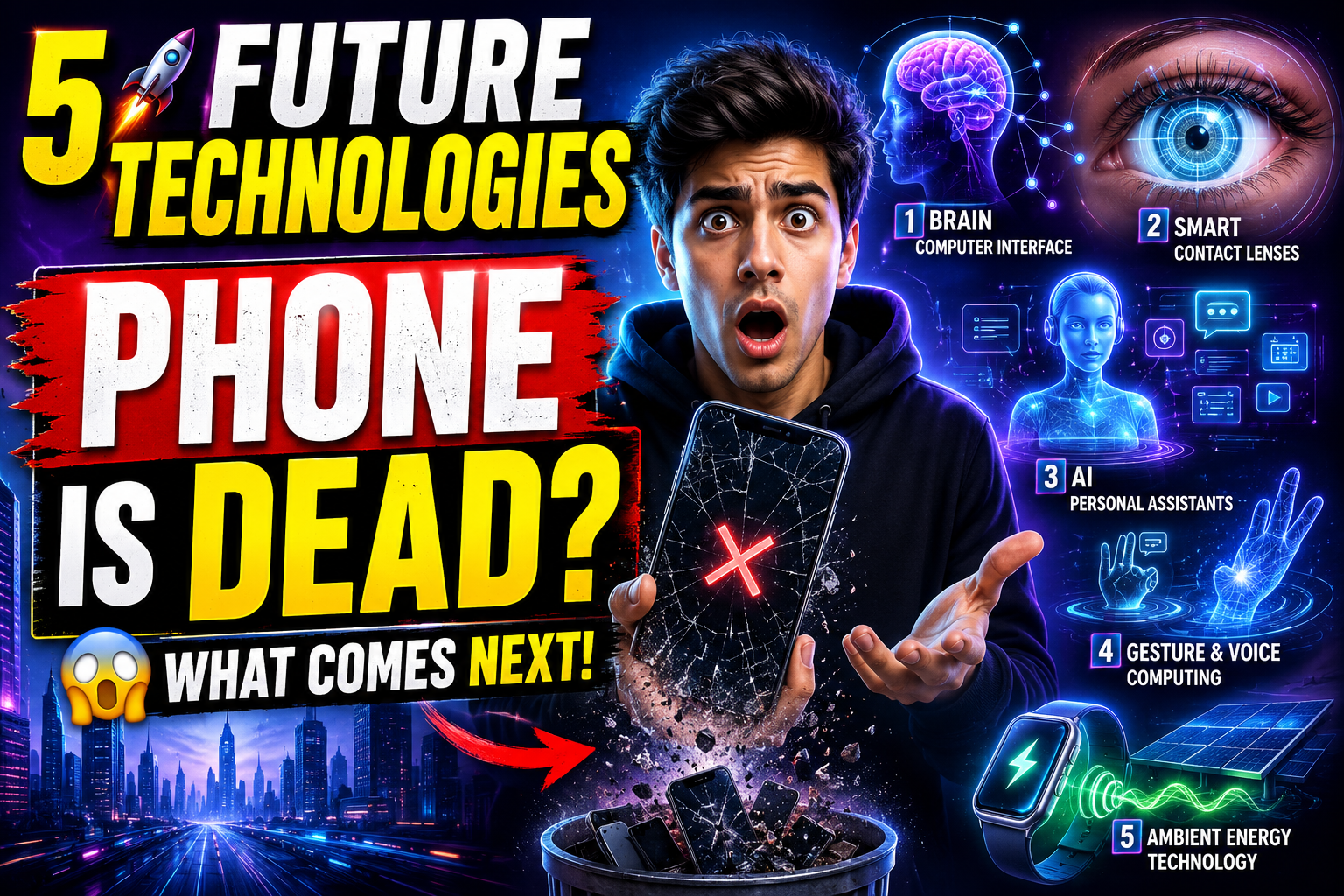
Imagine a World Without Smartphones…
Just a decade ago, the idea of carrying a powerful computer in your pocket seemed incredible. Today, smartphones, laptops, smartwatches, and even wireless earbuds have become an essential part of daily life. 📱⌚🎧
But technology never stands still.
The gadgets we rely on today may eventually become as outdated as floppy disks, DVD players, and fax machines. The future is being shaped by artificial intelligence, advanced computing, biotechnology, and immersive digital experiences that could completely change how humans interact with technology.
In fact, some of these future innovations are already being tested in laboratories and by major tech companies around the world.
So, what technologies could replace the gadgets we use every day?
Let’s explore five fascinating future technologies that may transform our lives sooner than most people expect.
1️⃣ Smart AR Glasses Could Replace Smartphones
👓 The End of Looking Down at Screens?
For years, smartphones have dominated the tech world. Whether we’re checking messages, watching videos, shopping online, or navigating maps, almost everything happens through a phone screen.
But the next big revolution may happen right in front of our eyes.
Augmented Reality (AR) glasses are becoming smarter, lighter, and more powerful. Instead of pulling out a smartphone, users could simply wear lightweight glasses that display information directly in their field of vision.
Imagine walking through a city and instantly seeing:
✅ Directions floating in front of you
✅ Real-time translations of foreign signs
✅ Incoming messages appearing in the corner of your vision
✅ AI assistants providing information instantly
No need to hold a device.
No need to constantly look down.
Everything becomes hands-free.
Why This Matters
One of the biggest problems with smartphones is distraction. People spend hours staring at screens every day.
AR glasses could create a more natural digital experience by blending technology into the real world.
Potential Challenges
- Privacy concerns
- Battery limitations
- Social acceptance
- Cost of production
Despite these obstacles, many experts believe AR glasses could become the next major computing platform.
2️⃣ Brain-Computer Interfaces May Replace Keyboards and Touchscreens
🧠 Controlling Technology With Your Thoughts
This sounds like science fiction.
But it’s already happening.
Brain-Computer Interfaces (BCIs) are technologies designed to allow direct communication between the human brain and computers.
Instead of typing on a keyboard or tapping a touchscreen, users could potentially control devices using neural signals.
Imagine:
💭 Writing an email by thinking.
💭 Moving a computer cursor without touching a mouse.
💭 Controlling smart home devices instantly.
💭 Communicating even when physically unable to speak.
This technology could be especially life-changing for people with disabilities.
A New Digital Era
Today’s computers require physical interaction.
Future computers may simply read intentions and convert them into actions.
Although widespread adoption may take years, BCIs could eventually replace many traditional input devices.
3️⃣ AI Personal Assistants Could Replace Multiple Gadgets
🤖 One Intelligent Assistant Instead of Many Devices
Think about how many gadgets people currently own:
- Smartphone
- Smartwatch
- Speaker
- Laptop
- GPS Device
- Fitness Tracker
What if a single AI assistant could handle all of them?
Future AI systems are expected to become significantly more intelligent and personalized.
Instead of opening apps, users may simply ask an AI assistant to complete tasks automatically.
For example:
“Book my flight.”
“Schedule my meetings.”
“Order groceries.”
“Summarize today’s news.”
The AI would manage everything seamlessly.
The Rise of Ambient Computing
Technology is gradually moving into the background.
Rather than interacting with gadgets, people may interact directly with intelligent systems that understand context and anticipate needs.
This shift could reduce dependence on multiple physical devices.
4️⃣ Holographic Displays Could Replace TVs and Monitors
🌟 Screens Without Screens
Televisions and computer monitors have evolved dramatically.
Yet they still rely on physical screens.
Future holographic technology may eliminate screens entirely.
Imagine walking into a room and seeing:
🎥 A floating movie display
🎮 A life-sized gaming environment
📊 Interactive business presentations suspended in mid-air
👨🏫 Virtual classrooms appearing around you
No monitor.
No projector.
Just realistic holographic visuals.
Why Holograms Could Change Everything
Holographic displays could create more immersive experiences than traditional screens.
Instead of watching content through a rectangle on a wall, users could experience digital content as part of their physical environment.
While current holographic technology remains expensive and limited, researchers continue making significant progress.
5️⃣ Quantum Computing Could Replace Traditional Supercomputers
⚛️ The Next Computing Revolution
Most modern devices rely on classical computing.
Quantum computing operates in a fundamentally different way.
Rather than using traditional bits that are either 0 or 1, quantum computers use quantum bits (qubits) that can exist in multiple states simultaneously.
This allows them to solve certain problems dramatically faster than today’s most powerful computers.
Potential applications include:
🔬 Drug discovery
🌎 Climate modeling
🔒 Advanced cybersecurity
🚗 Autonomous transportation
🧬 Genetic research
Why It Matters
Some calculations that might take traditional computers thousands of years could potentially be solved by quantum systems in a fraction of the time.
Although quantum computers won’t replace every laptop or smartphone, they could eventually replace many high-performance computing systems used by governments, scientists, and large organizations.
🌍 What Does This Mean for the Future?
History shows that every generation believes its technology will last forever.
Yet technology constantly evolves.
Cassette players disappeared.
DVD players declined.
Landline phones became less important.
Today’s most popular gadgets may eventually face the same fate.
The future will likely be defined by:
✨ Artificial Intelligence
✨ Augmented Reality
✨ Brain-Computer Interfaces
✨ Holographic Computing
✨ Quantum Processing
Some of these innovations may take years to become mainstream.
Others could arrive much sooner than expected.
One thing is certain:
The next technological revolution won’t simply improve today’s gadgets—it may completely replace them.
As exciting as modern technology already is, the future promises experiences that seem almost impossible today.
And when that future arrives, the devices we currently consider essential may become nothing more than fascinating pieces of technological history.